
Beer League Mailbag
What no one's ever told you about the fundamentals of hockey

Originally published August 2020
If you’re like me, then you love playing hockey even more than watching it on TV or reading about it online.
The thing I missed most when coaching at the AHL level was actually getting on the ice. Usually I was in the coaches’ room cutting video, researching stats or repairing printers.
Both recreational leagues I’ve signed up for are restarting in the next few days and I am psyched.
I wondered how many others were also looking forward to getting back on the ice:

1) The No. 1 thing no coach has ever told you
Hockey is a one-legged sport.
In game conditions players seldom have time to get their weight centered and set before having to make a pass or a shot.
As an adult you have a lot of catching up to do. Ice time can be expensive and public skating/pickup/drop-in/stick & puck sessions might be hard to find.
The best way for a beginner to get better off the ice is to grab a stick, find a ball (a hard orange street hockey ball or a wiffel ball) and do one-legged stickhandling drills such as the one below:
Benefits:
Improves general strength/balance
Improves ability to skill blend (manage your feet and your hands at the same time)
Easy to get reps in whether or not you have access to ice
2) Becoming a better pass receiver
“How can we complete more passes” is a question that more hockey players should be asking themselves, whether they are in their first year of Learn to Play or they are competing for a Stanley Cup.
Pay attention to how many passes your favorite team can string together in a possession sequence next time you watch the NHL on TV.
On average the chain breaks after 2-3 passes.
A particularly rigid dump-and-chase team such as the Philadelphia Flyers might go minutes without making two consecutive passes in transition.
As a team, here are some success factors and anti-goals to keep in mind when trying to hook up via the pass:
Success Factor 1: Distance
The shorter the pass, the easier it is to complete
Anti-goal: Don’t skate two zones away from the puck carrier and expect him/her to give you a perfect pass. Get closer.
Success Factor 2: Angle
The more lateral the pass (east/west), the easier it is to complete
Anti-goal: Don’t skate north with your back to the play, then hope to turn around at precisely the correct moment for a teammate to hit you for a breakaway.
Success Factor 3: Puck placement
First touch makes the play - the better your pass reception the more successful the rest of your possession with be.
Don’t rush your execution when the puck arrives at your stick blade. Settle down and catch the puck to your side instead of between your feet.
3) Attacking 1v1 off the rush
How to attack a defenseman 1 on 2 or 1 on 1, I have great edges and vision but stick work and shot are slow. - Nathan Schaper
Consider Nathan MacKinnon’s move against Seth Jones at the 2013 Memorial Cup:
MacKinnon beat Jones without having to stickhandle through him because he did the following two things well:
Change of angle & speed (faking to the middle, then creating separation with crossovers to the outside)
Body positioning/puck placement (putting his body squarely between the puck and Jone’s reach)
You don’t need to be overly fast or skilled to create space against a rec-league D-man. Just play around with your angle, speed and puck placement and you’ll create uncertainty in his mind, forcing him to give up his defensive blue line.
4) 4v4 tactics
What would you consider the go to breakout method for 4 on 4 hockey? And what would you draw up for a 4 on 3 PP/PK? - Juan Valle
Four-a-side hockey is tricky because the game tends to break down structurally, but here’s some general principles of how to play with the puck:
Puck Carrier (F1): Carry the puck up-ice via the dot lane (green line below), using change of speed/angle to create space.
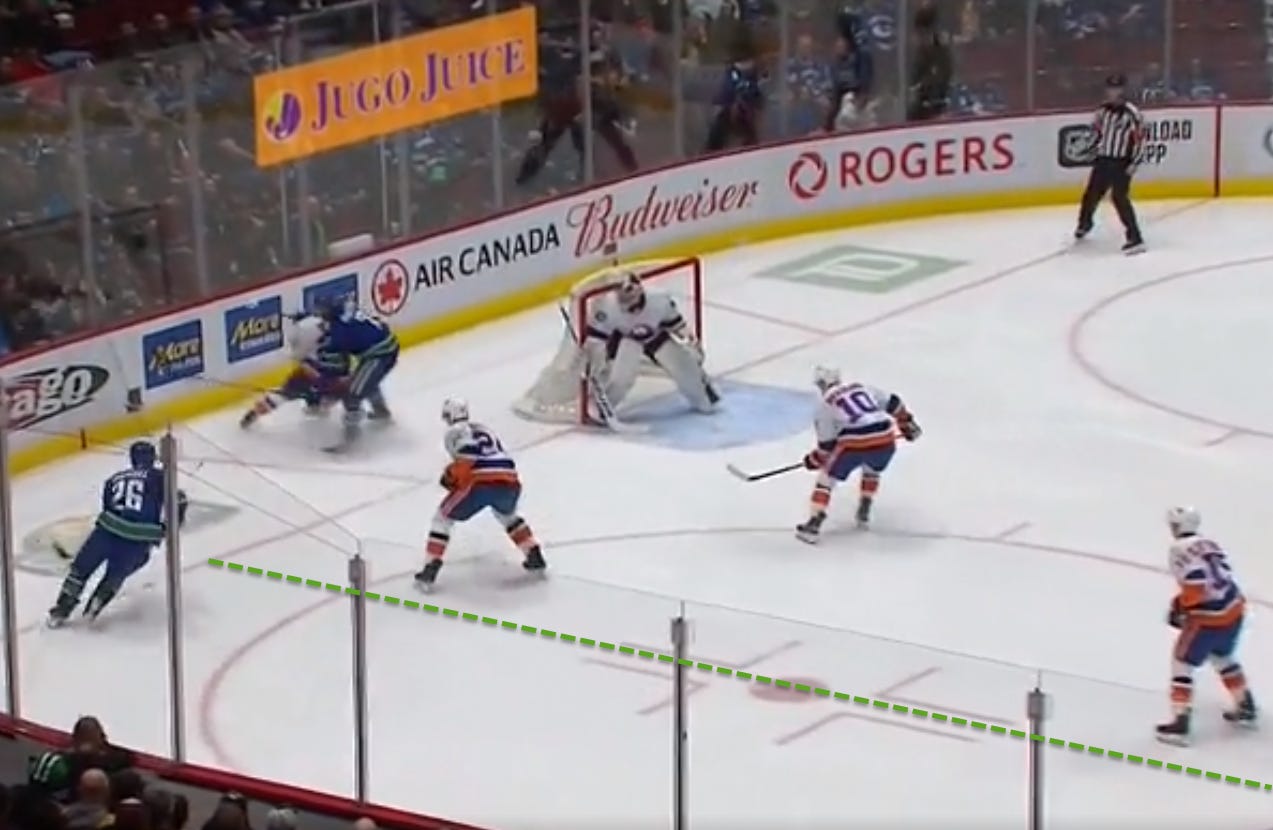
Support player (F2): Skate toward F1 as to create 2v1s against the nearest defender and provide an easy passing option.
Wide player (F3): Stay level with F1/F2 but on the opposite side of the ice, as to give them a change-of-side option against more aggressive defenders.
Free player (F4): Can either fall behind F1/F2 to provide defensive safety or push up-ice and be a breakaway option if the team is looking for goals.
The above principles work at even-strength or on the powerplay.
As for a 3v4 PK, have the top player (F1) cut the ice in half and herd the play to the boards. The bottom two players stay in the slot to prevent seam plays. Then hope for the best…
5) How to incorporate lesser players into a team
How to maximize a weaker player’s impact when they are playing with 2 skilled linemates in a league above their skill level (I’ve always wondered if it’s best to tell them to battle for pucks as hard as they can or tell them to hang around the front of the net with their stick on the ice. Happens a lot in beer league when a couple friends who don’t play want to join the team and feel involved.) - Tanner Keelan
Without knowing anything about the specific skillset of these weaker players, one way I would deploy them is as a center-forward (or a No.9 in traditional soccer numerology)
On breakouts: Have them threaten breakaways by skating out of the DZ between both opposing Ds. If they don’t get the puck then circle back and cover the strong side point. Repeat every time possession is in doubt.
In transition: Have them push out of the DZ early, then play with their backs to the opposing net. You’re looking to hit them with a long pass, which they catch standing still. Then they can bump the puck back to a stronger player who has speed underneath.
In the offensive zone: Have them stay around the net, grab loose pucks and slip them into the crease, as TBL14 Pat Maroon does in the sequence below:
Thanks to Pdx, Felix, Toby, Nathan, Juan & Tanner for the question. Let me know via email or Twitter how those tips worked out for you!
Looking to watch & think the game in a different way?
If you enjoy this newsletter and want to see more free content, consider ordering a copy of my e-book Hockey Tactics 2020, edited by a legendary journalist and illustrated by an artist whose work you have surely already seen. Eight chapters, more timely insights, more timeless principles. Get it now